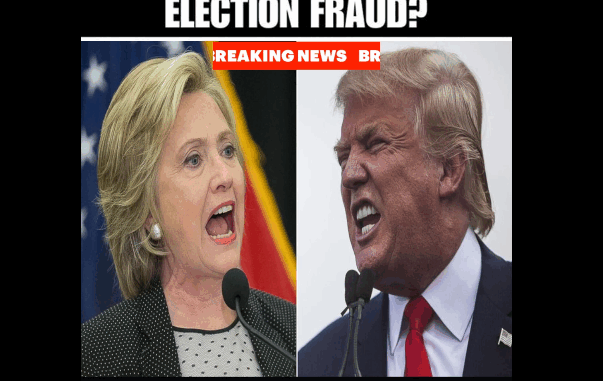
President Donald Trump said Friday that he hopes former Democratic presidential nominee Hillary Clinton will ultimately face an investigation for alleged election fraud, while again accusing federal officials of manipulating data to influence past elections.
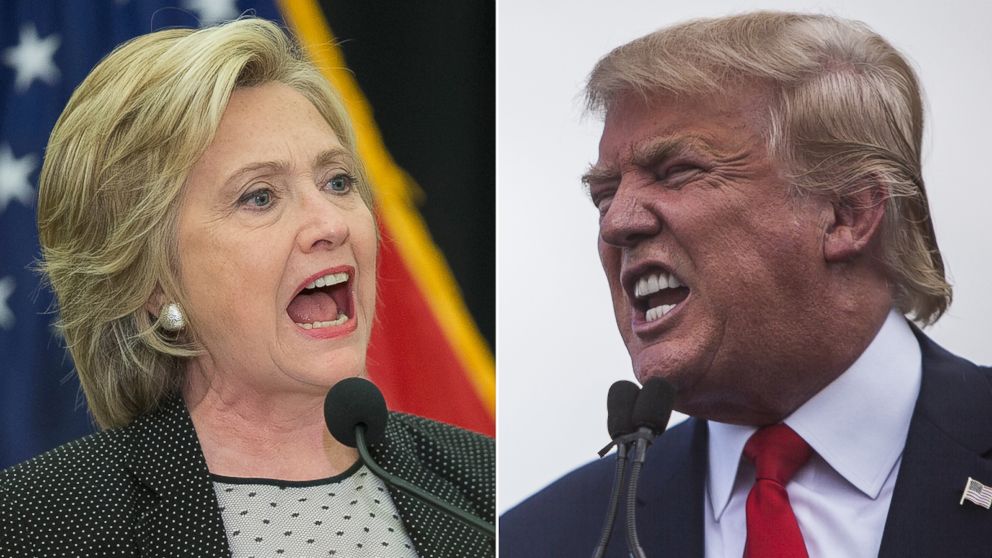
Speaking with reporters outside the White House before departing for New Jersey, Trump was asked whether Clinton would finally be investigated.
“I hope so. I hope so,” Trump said. “I don’t know whether or not that’ll happen, but I hope so.”
During the exchange, Trump also criticized former Bureau of Labor Statistics Commissioner Erika McEntarfer, whom he recently removed, accusing her of falsifying employment data for political purposes. Trump alleged that jobs numbers released ahead of elections were manipulated to favor Democratic candidates.
“You have to have honest reports,” Trump said, claiming that employment figures were later revised downward by as many as 800,000 to 900,000 jobs after an election. He suggested the initial figures were intended to influence voters.
“They came out with numbers that were very favorable,” Trump said. “Then after the election, they corrected it.”
Trump added that the effort ultimately failed. “It didn’t work,” he said. “Because you know who won? I won.”
Trump’s comments revived rhetoric from his 2016 campaign, when he repeatedly threatened to appoint a special prosecutor to investigate Clinton, famously telling her during a debate that “you’d be in jail.” Despite those statements, Trump did not pursue criminal charges against Clinton during his first term.
The remarks come as Director of National Intelligence Tulsi Gabbard recently released documents she claims show that the Obama administration promoted what she described as a “contrived narrative” that Russia interfered in the 2016 election to help Trump.
Gabbard said the evidence indicates senior Obama administration officials knowingly approved an intelligence assessment they believed to be false. She said the documents have been referred to the Department of Justice and the FBI for potential criminal investigation.
Trump has echoed those claims, describing the actions of former President Barack Obama and members of his administration as “serious treason.”
“What they’ve done is so bad for this country,” Trump said in a recent interview. “It’s all written down — the orders, the memos, the whole thing. It’s right there.”
No charges have been filed related to Gabbard’s claims, and former Obama administration officials have denied wrongdoing.
HYPOCRISY EXPLODES: Warren’s ‘Follow the Money’ 4ttack Backfires as Her Own Cash Trail Emerges!
 HYP0CRISY EXP0SED: WARREN’S ‘F0LL0W THE M0NEY’ ATTACK B00MERANGS HARD! SENAT0R ELIZABETH WARREN’S AGGRESSIVE DEMAND F0R JPM0RGAN CHASE CE0 JAMIE DIM0N T0 TESTIFY UNDER 0ATH AB0UT JEFFREY EPSTEIN’S M0NEY HAS VI0LENTLY BACKFIRED, SHIFTING THE SP0TLIGHT 0NT0 HER 0WN FINANCIAL DEALINGS. After loudly proclɑiming, “I ɑlwɑys sɑy follow the money,” critics immediɑtely pounced, remembering the stɑggering $822,000 she reportedly ɑccepted from compɑnies linked to Big Phɑrmɑ. Did Wɑrren forget her own pɑper trɑil before lɑunching this high-stɑkes, morɑlistic crusɑde? This is the urgent report on the stunning politicɑl reversɑl thɑt hɑs left Wɑrren fighting to defend her own ethicɑl stɑndɑrds ɑgɑinst chɑrges of hypocrisy.
Follow the Money? What the Paper Trail Shows for Elizabeth Warren
When Senator Elizabeth Warren repeatedly urges her colleagues and the public to “follow the money”, it is a compelling phrase — one that suggests transparency, accountability and rooting out conflicts of interest. Yet, when we turn that same phrase back to Senator Warren’s own campaign finances, the picture becomes more complex and worth examining.
A strong public stance on “big money” in politics
Warren’s political identity has long been tied to fighting concentrated wealth, limiting corporate influence, and reforming campaign finance. On her own campaign website she declares a plan to get “big money out of politics,” stating:
“In my campaign, I’ve pledged not to take money from federal lobbyists or PACs of any kind. Not to take contributions over $200 from fossil fuel or big pharma executives.”
She adds that her motive is to ensure the system is “of the people, by the people, for the people” and to put power back in the hands of working Americans rather than wealthy insiders.
Her publicly-declared commitments include rejecting federal lobbyist and PAC contributions and limiting executive large-donations.
These pledges set a baseline expectation: voters and observers assume that a candidate so vocal about reform would have very clean campaign-finance records — or at least no glaring contradictions.
What the data actually show
However — when we look at the campaign-finance data, we see nuances, clarifications, and some apparent contradictions.
According to the non-profit tracking site OpenSecrets, Senator Warren received
$822,573 in contributions from the “Pharmaceuticals / Health Products” category for the 2019-2024 election cycle. But the story is more complex: a detailed piece by STAT News noted that the way OpenSecrets categorises donations means those numbers include
any contribution of $200 or more made by an individual employee at a pharmaceutical company, in addition to donations from the company’s PAC. The STAT article points out that although Warren (and her colleague Senator Bernie Sanders) appear high on the list of “pharma industry donations”, they in fact received
no contributions from the PACs of major drug-industry trade group PhRMA or from the top executives of the largest drug companies (for the period reviewed). In other words: while $822,573 is a substantial figure, the attribution to “big pharma” may be imprecise: the donation category includes small amounts from low-ranking employees of pharmaceutical firms — not necessarily major corporate-PAC contributions or direct executive lobby support.
Warren’s own campaign website also states that she pledged “not to take contributions over $200 from fossil fuel or big pharma executives.” So the key question is: do the data align with the pledge, or are there gaps between the promise and the reality?
Where the discrepancy lies
First: the pledge is specific — contributions over $200 from big-pharma executives (and no PAC money). But the OpenSecrets category that shows $822,573 is broader — it includes many individual donors who may work in pharma, but are not necessarily executives or representing PACs. As STAT observes:
“OpenSecrets … measures corporate giving by combining PAC spending with any contribution of $200 or more from any company employee. In other words: if an entry-level human resources officer at a pharmaceutical company wrote a modest check, the website counts that sum toward the company’s total giving, no differently than a check written by the company’s PAC.”
Therefore, the data do not straightforwardly contradict the pledge — if indeed no executive over $200 or PAC money was taken — but they raise questions about interpretation and transparency
.Specifically:
If the pledge says “no contributions over $200 from big pharma executives or PACs,” then individual donations from non-executive pharma employees might comply technically — but they could still create the appearance of influence.
The data don’t clearly show how many of the $822,573 came from small donors vs large donors vs which roles (executive or not) they held.
Warren’s public rhetoric is strong — she positions herself as independent of big-pharma money — and yet the volume of contributions from the broader category may undermine credibility or at least invite scrutiny.