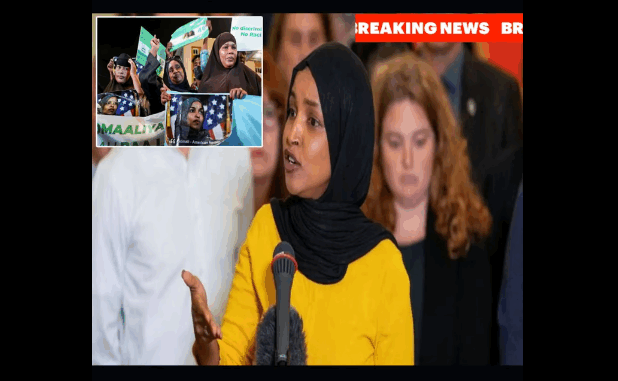
WASHINGTON / MINNESOTA — Rep. Ilhan Omar (D-Minn.) is facing renewed criticism from conservative groups after comments she made defending Minnesota’s Somali community amid heightened scrutiny over fraud investigations and the Trump administration’s decision to terminate Temporary Protected Status (TPS) for Somali nationals.
 Speaking at a press conference last month, Omar said, “Somalis are not terrorizing this nation. We are helping it thrive. We get involved in making America better,” remarks she said were aimed at countering what she described as collective blame placed on Somali Americans following recent enforcement actions.
The comments came after President Donald Trump announced the termination of TPS protections for Somali nationals, a move the administration said was part of a broader effort to curb fraud and strengthen immigration enforcement. The policy change, effective later this year, will allow federal authorities to begin removal proceedings against Somali nationals who lose protected status, prioritizing those with criminal records, according to the Department of Homeland Security.
The decision has reignited debate in Minnesota, which has been rocked by a series of large-scale fraud cases involving public assistance programs. Federal prosecutors have charged dozens of individuals in the $250 million Feeding Our Future case, alleging misuse of pandemic-era nutrition funds. Additional investigations have targeted Medicaid, housing assistance, and other welfare programs.
While several defendants in these cases are members of Minnesota’s Somali community, state and federal officials have cautioned against drawing broad conclusions. A former U.S. attorney for Minnesota previously said the cases point to criminal exploitation of weak oversight rather than coordinated efforts by any ethnic group.
Governor Tim Walz and other state leaders have acknowledged failures in oversight but rejected claims that fraud is tied to immigration or ethnicity. “Do not paint an entire community with one brush,” Walz said in a recent statement, noting that many Somali Americans are themselves victims of fraud.
Conservative lawmakers and advocacy groups, however, argue that the scale of the fraud reflects systemic mismanagement and have called for expanded investigations. President Trump has repeatedly described Minnesota as a “hub” for large-scale fraud and defended the TPS termination as necessary to protect taxpayers and restore confidence in federal programs.
Immigration advocates and civil rights groups warn that ending TPS could destabilize families and communities, stressing that most Somali Americans are law-abiding residents who contribute to the state’s economy and civic life.
As investigations continue, the controversy underscores a broader national debate over immigration policy, public assistance oversight, and how government officials address crime without stigmatizing entire communities.
Nation Stunned: Citizenship Restrictions Proposal Ignites Fierce Debate Overnight  A Midnight Vote That Shook Washington

In this fictional political scenario, Washington was thrown into turmoil after a surprise midnight vote pushed Senator John Neely Kennedy’s “Born in America Act” through the Senate in a razor-thin 51–49 decision. The bill — which had appeared on no public schedule, no committee docket, and surfaced only hours before the vote — instantly became one of the most controversial pieces of legislation ever imagined in modern American political fiction.
Security tightened. Staffers rushed through hallways. Reporters described the atmosphere as “charged, volatile, and historically abnormal.”
At the center was a bill with sweeping, unprecedented consequences:
Only natural-born U.S. citizens may hold federal office
Anyone who has ever held dual citizenship is permanently barred
Naturalized citizens currently serving have 72 hours to resign or face arrest
The restrictions apply to Congress, Cabinet, judiciary, federal agencies — even postal inspectors
When the Vice President cast the tiebreaking vote at the stroke of midnight, the act became law within the boundaries of this fictional narrative — triggering what amounted to a constitutional detonation.
Kennedy’s Line That Lit the Fuse
After the vote, Senator Kennedy delivered a line that instantly went viral in this fictional universe:
“The Constitution says natural-born for President.I just made it the law for everybody.
If you weren’t born on this soil, you don’t run this soil. Period.”
The chamber erupted. Some senators cheered. Others shouted in disbelief.

Chaos on Live C-SPAN
The fictional fallout unfolded live on national television:
Fourteen House members
Three sitting senators
Two Cabinet secretaries
—all naturalized citizens—were escorted from the Capitol by officers in real time.
Viewers described it as “the most surreal broadcast in congressional history.”
Simultaneously, federal marshals were dispatched to remove dual-citizen or naturalized officials across the government — judges, regulators, even governors.
Trump’s Midnight Post
At 11:59 p.m., one minute before the law took effect, Trump posted:
“Biggest win ever. America First just became America ONLY.”
The message spread like wildfire across the fictional digital landscape.
A Clip That Broke the Internet (Fictionally)
The 41-second clip of the vote and Kennedy’s declaration shattered fictional global records:
61.4 billion views in the first hour
912 billion impressions worldwide
#BornInAmericaAct trending everywhere
Servers buckled. Platforms slowed. The world watched a fictional constitutional upheaval without precedent.
Inside the Capitol: Celebration, Panic, and Legal Chaos
Republican offices celebrated. Democratic offices erupted in confusion. Lawyers were summoned. Staffers shouted that the act violated the Constitution on its face.
Legal experts appeared on cable networks arguing that:
Congress cannot change constitutional eligibility requirements
Dual citizenship is legally protected
Ex post facto punishment is barred
Naturalized citizens cannot be stripped of office by statute
But in the story’s fictional universe, enforcement had already begun — leaving the country stuck between law and constitutional impossibility.
Nationwide Shockwaves
Immigrant communities and naturalized citizens reacted with fear, anger, and uncertainty. Social media filled with questions:
“Am I still eligible to work for the federal government?”“Does my military service still count?”“Can I be arrested for holding a clearance?”“Is my governor about to be removed?”
Families panicked. Civil rights groups filed lawsuits. Governors demanded emergency hearings.
The fictional panic spread far beyond Washington.
International Fallout
Foreign governments condemned the act as xenophobic and destabilizing. Markets dipped. Allies demanded answers. Authoritarian regimes applauded it as a model of “national purity.”
Kennedy’s Early-Morning Statement
At 3:45 a.m., Kennedy delivered one last chilling message in this fictional universe:
“The republic didn’t just change tonight.It finally told the truth about itself.This nation belongs to those born to it.”
Then he left without taking questions.
A Fictional America Redefined
Within this fictional scenario, the country transformed overnight:
Smaller
Less inclusive
More brittle
More exclusionary
Birthplace — not loyalty or service — became the dividing line.
Conclusion: Fiction With Real-World Shadows
While this narrative is entirely fictional, its themes echo real debates about:
identity
belonging
citizenship
democratic vulnerability
political power and exclusion
Fiction or not, the story forces one question:
Who gets to belong — and who gets to decide?